
You’ve decided to refinish your hardwood floors. You get a few estimates, and suddenly you’re looking at very different prices for what seems like the same job. What gives?
One hardwood flooring company is much cheaper than another.
If they’re both sanding and refinishing the same floors, why does one cost so much more?
The answer is often in the small details that don’t show up on the final invoice.
At Powell Flooring, we encourage homeowners to compare estimates carefully because two contractors quoting “hardwood floor refinishing” may be offering very different levels of preparation, products, equipment, and craftsmanship.
Before choosing the lowest price, make sure you’re actually comparing apples to apples.

Sanding Is More Than Removing the Old Finish
Sanding is one of the most important parts of hardwood floor refinishing, and it’s also an area where contractors can save considerable time and labor.
A lower-cost refinishing job may involve only one or two sanding stages before moving on to the finish.
A more thorough professional process involves multiple sanding stages using increasingly fine grits. Depending on the floor's condition and your desired result, our process may require four or five sanding stages to flatten, smooth, and properly prepare the wood.
Why does that matter?
Think about sanding a piece of fine furniture. A coarse grit removes the old surface quickly, but it also leaves sanding marks and scratches. Progressively finer grits remove the scratches created by the previous grit and prepare the wood for its final finish.
Skipping steps saves time.
It can also leave imperfections that become much more noticeable once you apply stain and finish.
The quality of a refinished hardwood floor starts long before the first coat of finish goes down.
Not All Hardwood Floor Finishes Are Equal
The word “finish” on two estimates doesn't necessarily mean you're getting the same product.
You can buy flooring finishes at big-box home improvement stores. Professional-grade hardwood flooring systems are also designed for contractors and demanding residential applications.
The price difference between products can be significant.
So can their performance characteristics.
Professional flooring finishes may offer advantages in durability, cure time, clarity, chemical resistance, appearance, and long-term wear. The right product also depends on the floor, household, desired look, and application.
When comparing hardwood flooring estimates, don't simply ask:
“How many coats of finish do I get?”
Ask:
“What exact finish are you using?”
Then compare the products themselves.
Three coats of one product are not automatically equivalent to three coats of another.
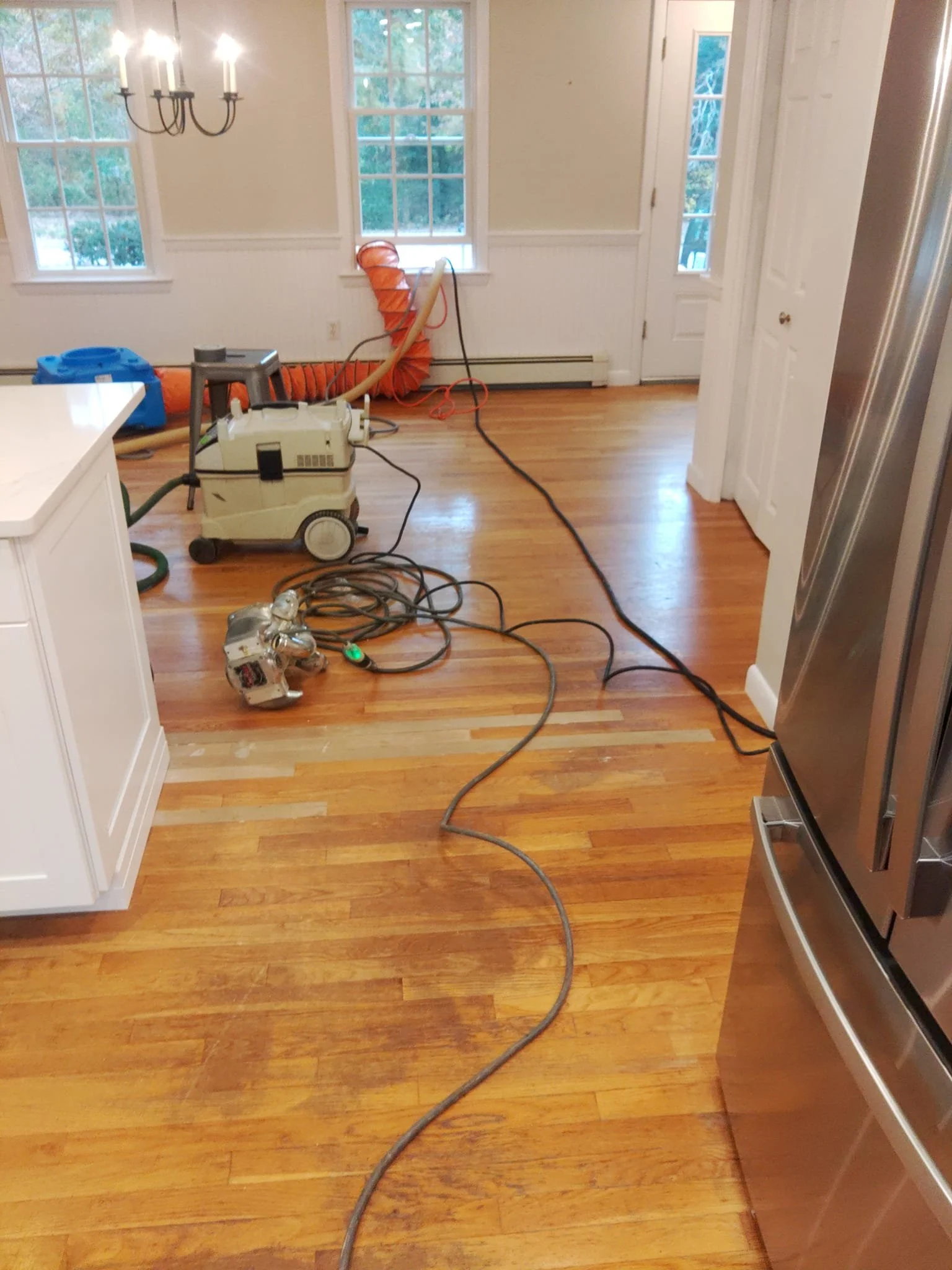
Hardwood floor sanding creates dust. Professional dust-containment equipment can dramatically reduce what escapes into your home, but homeowners should understand what a contractor means when they call their process “dustless.”
What Does “Dustless Sanding” Actually Mean?
Hardwood floor sanding creates dust. Professional dust-containment equipment can dramatically reduce what escapes into your home, but homeowners should understand what a contractor means when they call their process “dustless.”
At Powell Flooring, dust management isn't just about connecting a vacuum to a sanding machine.
We use professional dust-containment practices, air scrubbers, and extra cleaning steps to minimize airborne particles and prepare the space before we apply the finish.
That takes equipment.
It takes labor.
And importantly, it takes time.
A crew that spends additional time containing dust, cleaning surfaces, managing air quality, and preparing the floor may cost more than a crew that sands the floor and moves immediately to the next step.
You might not see that difference listed as a line item on your estimate.
You'll appreciate it when you don't find flooring dust throughout your home afterward.

hardwood floor installation
You're Also Paying for Time
This may be the biggest difference between two hardwood floor refinishing estimates.
Imagine one crew can complete a project in three days by eliminating sanding stages, minimizing cleaning time, and using less expensive materials.
Another company needs five days because they add extra sanding stages, thoroughly clean between steps, use professional dust-control equipment, and allow time for each step.
The second contractor has more labor hours, equipment time, and material costs invested in the same square footage.
Naturally, those two jobs won't cost the same.
The question isn't simply: “Why is this company more expensive?”
A better question is: “What am I getting for the difference?”
Ask These Questions Before Choosing a Hardwood Flooring Company
If you're comparing hardwood floor refinishing companies in Plymouth, MA, or the surrounding South Shore and Cape Cod communities, ask each contractor the same questions:
What is your complete sanding process? Ask how many sanding stages they typically perform and what grit sequence they use.
What brand and specific flooring finish will you use? Don't settle for “water-based” or “oil-based.” Ask for the actual product.
How do you control dust? Ask about sanding equipment, dust containment, air scrubbers, and cleaning procedures.
What preparation and cleaning are included? Find out what happens between the initial sanding and final coat.
How many coats are included? Confirm whether stain, sealer, and finish coats are being counted separately.
Are repairs included? If boards need replacement or other problems are discovered, understand how those are handled.
How long will the project take? A dramatically shorter timeline isn't always an advantage. Ask what allows the contractor to complete the project faster.
What isn't included in the estimate? This is often just as important as what is included.
The Cheapest Hardwood Flooring Quote Can Become Expensive
Hardwood floors differ from many home improvement projects because mistakes aren't easy to hide.
Poor preparation, sanding marks, uneven stain, contamination, or finish problems can mean repeating parts of the job. In the worst case, correcting a poorly refinished floor can require sanding it again and removing another layer of wood.
Hardwood floors can only be sanded a limited number of times during their lifespan.
That's why saving money on the initial project isn't much of a bargain if you have to correct the work later.
Compare the Work, Not Just the Price
We're not suggesting that the highest flooring estimate is automatically the best.
We're suggesting something much simpler: Know what you're buying.
If Contractor A and Contractor B use the same sanding process, comparable professional-grade products, equivalent dust-control equipment, the same number of finish coats, and similar preparation procedures, then comparing their prices makes sense.
But if one company offers a fundamentally different process, you're no longer comparing prices for the same service.
You're comparing two different services.
At Powell Flooring, we'd rather take the time to explain our process so homeowners understand exactly what they're paying for and why each step matters.
Looking for Hardwood Floor Refinishing in Plymouth, MA?
Powell Flooring provides professional hardwood floor installation, sanding, refinishing, and restoration throughout Plymouth County, Barnstable County, the South Shore, and Cape Cod.
If you're collecting hardwood flooring estimates, we're happy to explain our process, the products we recommend, and exactly what's included in your project so you can make an informed decision.